

DOWNLOAD the newest Actual4Dumps OGEA-103 PDF dumps from Cloud Storage for free: https://drive.google.com/open?id=13zACAbHP71jASqDCntIcDtfT9ntugxfo
With OGEA-103 guide torrent, you may only need to spend half of your time that you will need if you didn’t use our products successfully passing a professional qualification exam. In this way, you will have more time to travel, go to parties and even prepare for another exam. The benefits of OGEA-103 Study Guide for you are far from being measured by money. OGEA-103 guide torrent has a first-rate team of experts, advanced learning concepts and a complete learning model. You give us a trust and we reward you for a better future.
The OGEA-103 Exam is a rigorous and comprehensive certification program that provides professionals with the knowledge and skills needed to become effective enterprise architects. It is an essential qualification for anyone seeking to advance their career in enterprise architecture and is recognized by organizations around the world as a mark of excellence in this field.
The TOGAF Enterprise Architecture Combined Part 1 and Part 2 Exam (OGEA-103) web-based practice test works on all major browsers such as Safari, Chrome, MS Edge, Opera, IE, and Firefox. Users do not have to install any excessive software because this OGEA-103 practice test is web-based. It can be accessed through any operating system like Windows, Linux, iOS, Android, or Mac. Another format of the practice test is the desktop software. It works offline only on Windows. Our TOGAF Enterprise Architecture Combined Part 1 and Part 2 Exam (OGEA-103) desktop-based practice exam software comes with all specifications of the web-based version.
The TOGAF Enterprise Architecture Combined Part 1 and Part 2 Exam certification is highly valued in the industry and is recognized globally. It is a great way to demonstrate your knowledge and expertise in enterprise architecture and can help you advance your career. TOGAF Enterprise Architecture Combined Part 1 and Part 2 Exam certification is also a valuable asset for organizations as it demonstrates their commitment to using industry-recognized best practices in enterprise architecture.
The OGEA-103 Exam covers a range of topics, including the TOGAF Architecture Development Method (ADM), architecture content framework, enterprise continuum, architecture capability framework, stakeholder management, and architecture governance. OGEA-103 exam requires a deep understanding of these topics and the ability to apply them in real-world scenarios.
NEW QUESTION # 61
Exhibit: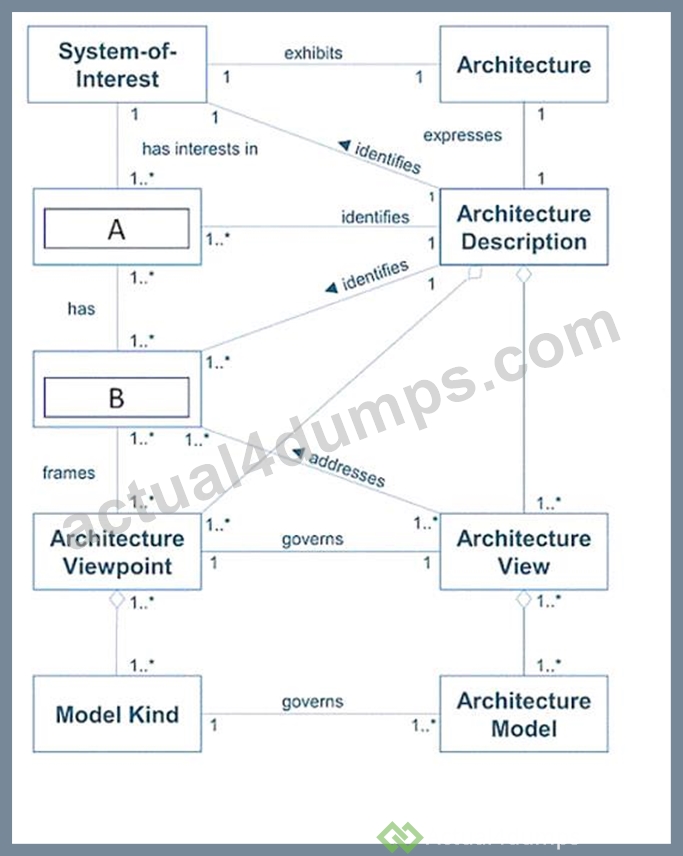
Consider the image showing basic architectural concepts.
What are items A and B?
Answer: D
Explanation:
In the context of TOGAF, a stakeholder is any individual, team, or organization who has interests in, or concerns relative to, the outcome of the architecture. Concerns are those interests which pertain to any aspect of the system's functioning, development or operation, including considerations such as performance, reliability, and security1. References:
*The TOGAF Standard, Version 9.2 - Definitions - The Open Group
NEW QUESTION # 62
Which of the following describes how the Enterprise Continuum is used when developing an enterprise architecture?
Answer: A
Explanation:
The Enterprise Continuum consists of two complementary concepts: the Architecture Continuum and the Solutions Continuum1. The Architecture Continuum provides a consistent way to describe and understand the generic and reusable architecture building blocks, such as models, patterns, and standards, that can be applied and tailored to specific situations2. The Solutions Continuum provides a consistent way to describe and understand the specific and implemented solution building blocks, such as products, services, and components, that realize the architecture building blocks3. The Enterprise Continuum enables the reuse and integration of architecture and solution assets across different levels of abstraction, scope, and detail, ranging from foundation architectures to organization-specific architectures1.
The Enterprise Continuum is used when developing an enterprise architecture to support the following activities1:
* Selecting relevant architecture and solution assets from the Architecture Repository or other sources, based on the business drivers, goals, and requirements
* Adapting and customizing the architecture and solution assets to suit the specific needs and context of the enterprise
* Defining and developing the target architecture and the architecture roadmap, based on the gaps and opportunities identified between the baseline and the target states
* Defining and developing the implementation and migration plan, based on the architecture roadmap and the solution building blocks
* Governing and managing the architecture and solution assets throughout the architecture lifecycle, ensuring their quality, consistency, and compliance
NEW QUESTION # 63
Which of the following is a responsibility of an Architecture Board?
Answer: A
Explanation:
Explanation
The Architecture Board is a governance body that oversees and supports the implementation of architectures within an organization. One of its responsibilities is to conduct assessments of the maturity level of architecture discipline within the organization using frameworks such as CMMI or ACMM. This helps to identify areas for improvement and monitor progress towards achieving higher levels of maturity. References:
https://pubs.opengroup.org/architecture/togaf9-doc/arch/chap44.html
NEW QUESTION # 64
Please read this scenario prior to answering the question
Your role is that of a senior architect, reporting to the Chief Enterprise Architect, at a medium-sized company with 400 employees. The nature of the business is such that the data and the information stored on the company systems is their major asset and is highly confidential.
The company employees travel extensively for work and must communicate over public infrastructure using message encryption, VPNs, and other standard safeguards. The company has invested in cybersecurity awareness training for all its staff. However, it is recognized that even with good education as well as system security, there is a dependency on third-parly suppliers of infrastructure and software.
The company uses the TOGAF standard as the method and guiding framework for its Enterprise Architecture (EA) practice. The CTO is the sponsor of the activity.
The Chief Security Officer (CSO) has noted an increase in ransomware (malicious software used in ransom demands) attacks on companies with a similar profile. The CSO recognizes that no matter how much is spent on education, and support, it is likely just a matter of time before the company suffers a significant attack that could completely lock them out of their information assets.
A risk assessment has been done and the company has sought cyber insurance that includes ransomware coverage. The quotation for this insurance is hugely expensive. The CTO has recently read a survey that stated that one in four organizations paying ransoms were still unable to recover their data, while nearly as many were able to recover the data without paying a ransom. The CTO has concluded that taking out cyber insurance in case they need to pay a ransom is not an option.
Refer to the scenario
You have been asked to describe the steps you would take to improve the resilience of the current architecture?
Based on the TOGAF standard which of the following is the best answer?
Answer: B
Explanation:
Business continuity is the ability of an organization to maintain essential functions during and after a disaster or disruption. Business continuity requirements are the specifications and criteria that define the acceptable level of performance and availability of the business processes and services in the event of a disaster or disruption. A gap analysis is a technique that compares the current state of the architecture with the desired state, and identifies the gaps or differences that need to be addressed. A change request is a formal proposal for an amendment to some product or system, such as the architecture. A Request for Architecture Work is a document that describes the scope, approach, and expected outcomes of an architecture project123 The best answer is A, because it describes the steps that would improve the resilience of the current architecture, which is the ability to withstand and recover from a ransomware attack or any other disruption. The steps are:
Determine the business continuity requirements, which specify the minimum acceptable level of performance and availability of the business processes and services in case of a ransomware attack. This would involve identifying the critical business functions, the recovery time objectives, the recovery point objectives, and the dependencies and resources needed for recovery.
Undertake a gap analysis of the current Enterprise Architecture, which compares the current state of the architecture with the desired state based on the business continuity requirements. This would involve assessing the strengths and weaknesses of the current architecture, the risks and opportunities for improvement, and the gaps or differences that need to be addressed.
Make recommendations for change requirements to address the situation and create a change request. This would involve proposing solutions and alternatives to close the gaps, enhance the resilience, and mitigate the risks of the current architecture. The change request would document the rationale, scope, impact, and benefits of the proposed changes, and seek approval from the relevant stakeholders.
Manage a meeting of the Architecture Board to assess and approve the change request. The Architecture Board is a governance body that oversees the architecture work and ensures compliance with the architecture principles, standards, and goals. The meeting would involve presenting the change request, discussing the pros and cons, resolving any issues or conflicts, and obtaining the approval or rejection of the change request.
Once approved, produce a new Request for Architecture Work to activate an ADM cycle to carry out a project to define the change. The Request for Architecture Work would describe the scope, approach, and expected outcomes of the architecture project that would implement the approved change request. The Request for Architecture Work would initiate a new cycle of the Architecture Development Method (ADM), which is the core process of the TOGAF standard that guides the development and management of the enterprise architecture.
NEW QUESTION # 65
Please read this scenario prior to answering the question
You are the Chief Enterprise Architect at a large food service company specializing in sales to trade and wholesale, for example, restaurants and other food retailers.
One of your company's competitors has launched a revolutionary product range and is running a very aggressive marketing campaign. Your company's resellers are successively announcing that they are not interested in your company's products and will sell your competitor's.
The CEO has stated there must be significant change to address the situation. He has made it clear that new markets must be found for the company's products, and that the business needs to pivot, and address the retail market as well as the existing wholesale market.
A consideration is the company's ability and willingness to change its business model, and if it is a temporary or permanent change. An additional risk factor is one of culture. The company has been used to a stable business with a reasonably well known and settled client base - all with its own local understandings and practices.
The CEO is the sponsor of the EA program within the company. You have been engaged with the sales, logistics, production, and marketing teams, enabling the architecture activity to start. An Architecture Vision, Architecture Principles, and Requirements have all been agreed. As you move forward to develop a possible Target Architecture you have identified that some of the key stakeholders' preferences are incompatible. The incompatibilities are focused primarily on time-to-market, cost savings, and the need to bring out a fully featured product range, but there are additional factors.
Refer to the scenario
You have been asked how you will address the incompatibilities between key stakeholder preferences.
Based on the TOGAF standard which of the following is the best answer?
Answer: C
Explanation:
According to the TOGAF standard, the Target Architecture is the description of a future state of the architecture being developed for an organization. It should be aligned with the Architecture Vision, Principles, and Requirements that have been agreed with the stakeholders. To address the incompatibilities between key stakeholder preferences, the TOGAF standard recommends creating and evaluating multiple alternative Target Architectures that meet different sets of criteria. These criteria should reflect the value preferences and priorities of the stakeholders, as well as the business drivers and objectives. The alternative Target Architectures should be illustrated using a set of architecture views that show the impact of each alternative on the business, data, application, and technology domains. The impact on planned projects should also be identified and analyzed. The strengths and weaknesses of each alternative should be understood and documented. A formal stakeholder review should then be conducted to decide which alternative is the most fit for purpose and should be moved forward with. The funding required for implementing the chosen alternative should also be determined and secured. References:
* The TOGAF Standard, Version 9.2 - Phase B: Business Architecture - The Open Group
* The TOGAF Standard, Version 9.2 - Phase C: Information Systems Architectures - The Open Group
* [The TOGAF Standard, Version 9.2 - Phase D: Technology Architecture - The Open Group]
* [The TOGAF Standard, Version 9.2 - Phase E: Opportunities and Solutions - The Open Group]
* [The TOGAF Standard, Version 9.2 - Phase F: Migration Planning - The Open Group]
NEW QUESTION # 66
......
Reliable OGEA-103 Study Plan: https://www.actual4dumps.com/OGEA-103-study-material.html
P.S. Free 2025 The Open Group OGEA-103 dumps are available on Google Drive shared by Actual4Dumps: https://drive.google.com/open?id=13zACAbHP71jASqDCntIcDtfT9ntugxfo
