

P.S. Free & New CKAD dumps are available on Google Drive shared by Test4Sure: https://drive.google.com/open?id=1OzRa2k3qvqse6cVy0oT3xL1LT2RfyMyt
Under the help of our CKAD training materials, the pass rate among our customers has reached as high as 98% to 100%. Our CKAD training materials have been honored as the panacea for the candidates for the exam since all of the contents in the CKAD guide materials are the essences of the exam. Consequently, with the help of our CKAD Study Materials, you can be confident that you will pass the CKAD exam and get the related certification as easy as rolling off a log. So what are you waiting for? Just take immediate actions!
Linux Foundation CKAD authentication certificate is the dream IT certificate of many people. Linux Foundation certification CKAD exam is a examination to test the examinees' IT professional knowledge and experience, which need to master abundant IT knowledge and experience to pass. In order to grasp so much knowledge, generally, it need to spend a lot of time and energy to review many books. Test4Sure is a website which can help you save time and energy to rapidly and efficiently master the Linux Foundation Certification CKAD Exam related knowledge. If you are interested in Test4Sure, you can first free download part of Test4Sure's Linux Foundation certification CKAD exam exercises and answers on the Internet as a try.
Want to crack the Linux Foundation CKAD certification test in record time? Look no further than Test4Sure! Our updated CKAD Dumps questions are designed to help you prepare for the exam quickly and effectively. With study materials available in three different formats, you can choose the format that works best for you. Trust Test4Sure to help you pass the Linux Foundation CKAD Certification test with ease.
Kubernetes is an orchestrator that works with Docker containers. The main components are similar to basic Docker containers. Not difficult to use, but you can't go deep into it. Dedicated to running Docker containers. You can run your software on it, but you can't change the core of Kubernetes. The advantage is that you can use everything as-is or integrate with different cloud providers. The reason for this is that Kubernetes is more focused on operations than Docker. Provides very good support for running multi-container orchestrations. It's easy to install and configure.
You can use it on any cloud provider or locally, and it runs on different operating systems, including Windows. Knowledge of Docker commands or installation is not required. You can use it as a service from DigitalOcean. Kubernetes provides better support for your application. Users can scale up and down your infrastructure according to their needs. You can also define what containers to run on the nodes, which is not the case for Docker. CNCF CKAD Dumps is a simple way to pass this exam. You can make use of it without knowing too much about Docker or Kubernetes. The Kubernetes from Google is fully open source and free for everyone, but you need to buy a license if you want to use it on public clouds.
NEW QUESTION # 81
You're building a Kubernetes application that manages user profiles and requires a custom resource for storing profile information. Design a custom resource definition (CRD) and its corresponding controller, ensuring that every time a profile is created or updated, a unique user ID is assigned to the profile.
Answer:
Explanation:
See the solution below with Step by Step Explanation.
Explanation:
Solution (Step by Step) :
1. Create the Custom Resource Definition (CRD)I
- Define the CRD Spec: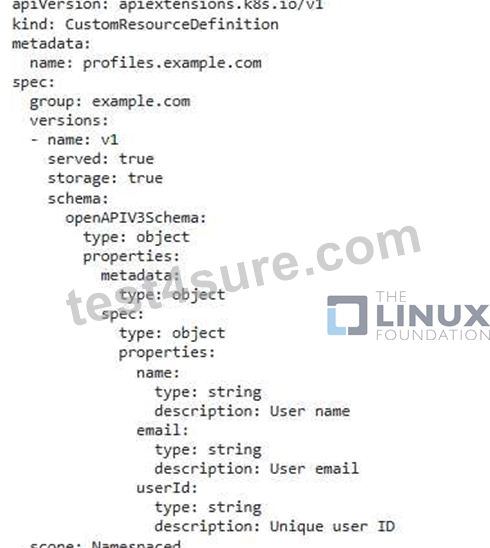
- Apply the CRD: bash kubectl apply -f profile-crd_yaml 2. Create a Controller for the Custom Resource: - Define the Controller Logic: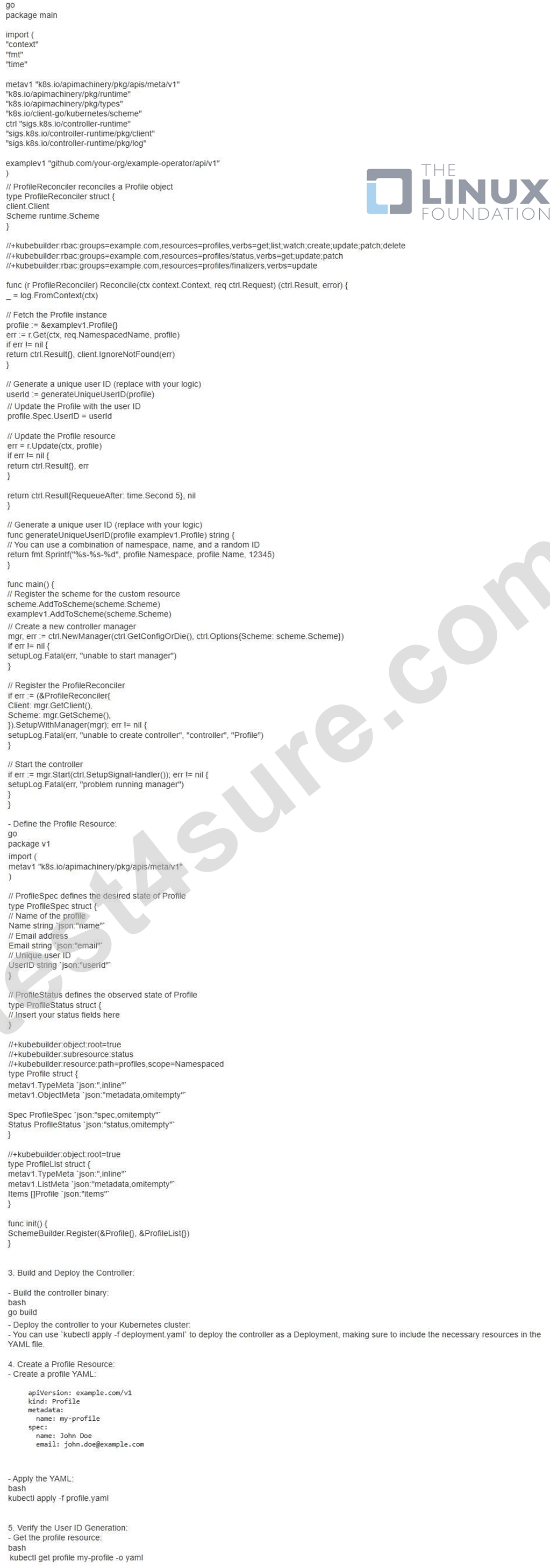
- Check the 'userld' field in the output You should see the automatically generated unique user ID. This comprehensive solution demonstrates how to implement a custom resource definition and a controller for managing user profiles in Kubernetes. You can adjust the code and logic according to your specific requirements. ,
NEW QUESTION # 82
You have a Deployment named 'web-app-deployment that runs 5 replicas of a web application container. You need to ensure that only one pod iS updated at a time during a rolling update. Additionally, you want to set the update strategy so that no more than 2 pods are unavailable at any given time.
Answer:
Explanation:
See the solution below with Step by Step Explanation.
Explanation:
Solution (Step by Step) :
I). Update the Deployment YAMI-:
- Update the 'replicas' to 5.
- Define 'maxunavailable: 1 ' and 'maxSurge: 2 in the 'strategy.rollingUpdate' section to control the rolling update process.
- Configure a 'strategy.types to 'RollinglJpdate' to trigger a rolling update when the deployment is updated.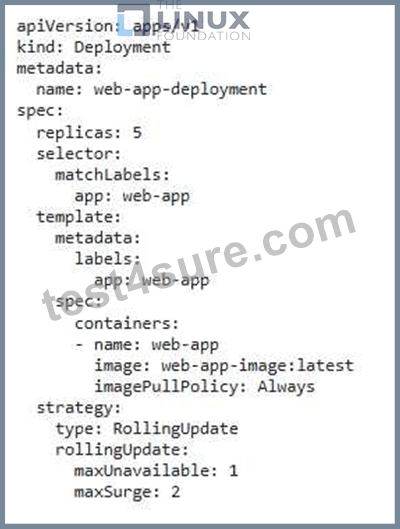
2. Create the Deployment: - Apply the updated YAML file using 'kubectl apply -f web-app-deployment-yamr 3. Verify the Deployment: - Check the status of the deployment using 'kubectl get deployments web-app-deployment to confirm the rollout and updated replica count. 4. Trigger the Automatic Update: - Push a new image to the 'web-app-image:latest' Docker Hub repository 5. Monitor the Deployment: - Use 'kubectl get pods -I app=web-app' to monitor the pod updates during the rolling update process. You will observe that one pod is terminated at a time, while one new pod with the updated image is created. Additionally, you'll see that the number of unavailable pods never exceeds 2. 6. Check for Successful Update: - Once the deployment is complete, use "oubect1 describe deployment web-app-deployment' to see that the 'updatedReplicas' field matches the 'replicas' field, indicating a successful update.
NEW QUESTION # 83
You are deploying a new microservice called 'payment-service' that requires access to a confidential data volume mounted at /sensitive- data'. This volume is mounted as a Secret in Kubernetes. The 'payment-service' container should only be allowed to access this volume. You need to configure the PodSecurityPolicy to enforce this access restriction.
Answer:
Explanation:
See the solution below with Step by Step Explanation.
Explanation:
Solution (Step by Step) :
I). Create a PodSecurityPoIicy:
- Create a YAML file for your P0dSecurityP01icy.
- Define the 'apiVersion' and 'kind'
- Add a 'metadata' section with a unique name for the policy (e.g., 'payment-service-psp').
- In the 'spec' section:
- Set 'runAsUser' to ' RunAsAny' to allow any user ID.
- Set readOnlyRootFilesystem' to 'talse' to allow modifications within the container.
- Set 'hostNetworR to 'false' to avoid using the host's network.
- Set 'allowPrivilegeEscalatiorU to 'false' to prevent privilege escalation.
- In the 'volumes' sectiom
- Define 'hostPath' as the allowed volume type with the specified path "Isensitive-data'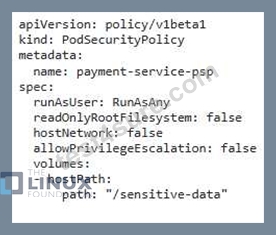
2. Apply the PodSecurityPolicy: - Use ' kubectl apply -f payment-service-psp.yamr to create the PodSecurityPoIicy in your cluster. 3. Create a ServiceAccount: - Create a new ServiceAccount tor the 'payment-service deployment. - Apply the ServiceAccount YAML file using 'kubectl apply -f payment-service-sa_yamr 4. Bind the PodSecurityPolicy to the ServiceAccount: - Create a RoleBinding to bind the 'payment-service-psp' to the 'payment-service' ServiceAccount - Apply the RoleBinding YAML file using "kubectl apply -f payment-service-rb.yaml'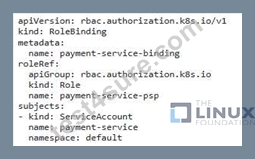
5. Deploy the Payment Service: - Create the 'payment-service' Deployment configuration. - Specify the 'payment-service' ServiceAccount in the field. - Define the 'volumeMount tor the 'sensitive-data' volume and specify the corresponding 'volume' in the 'volumes' section. - Ensure the volume is mounted as a Secret from the 'default' namespace.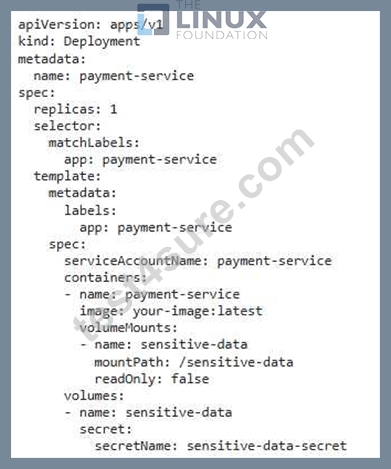
- The PodSecurityPolicy restricts the benavior of pods and their containers. - 'runAslJser' , 'readOnlyRootFilesystem', 'hostNetwork' , and sallowPrivilegeEscalation' define various security constraints for the container. - The 'volumes' section specifies allowed volume types (e.g., 'hostPath') and paths. - The ServiceAccount binds the PodSecurityPolicy to the deployment. - The ROIeBinding assigns the PodSecurityPolicy to the ServiceAccount, effectively enforcing the specified constraints. This configuration ensures that only the payment-service' deployment can access the confidential data volume mounted as a Secret in Kubernetes.
NEW QUESTION # 84
Context
Anytime a team needs to run a container on Kubernetes they will need to define a pod within which to run the container.
Task
Please complete the following:
* Create a YAML formatted pod manifest
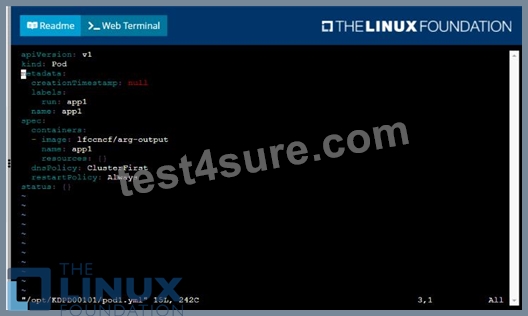
/opt/KDPD00101/podl.yml to create a pod named app1 that runs a container named app1cont using image Ifccncf/arg-output with these command line arguments: -lines 56 -F
* Create the pod with the kubect1 command using the YAML file created in the previous step
* When the pod is running display summary data about the pod in JSON format using the kubect1 command and redirect the output to a file named /opt/KDPD00101/out1.json
* All of the files you need to work with have been created, empty, for your convenience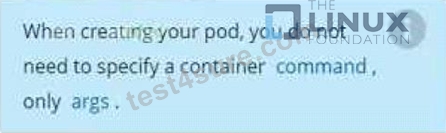
Answer:
Explanation:
Solution:
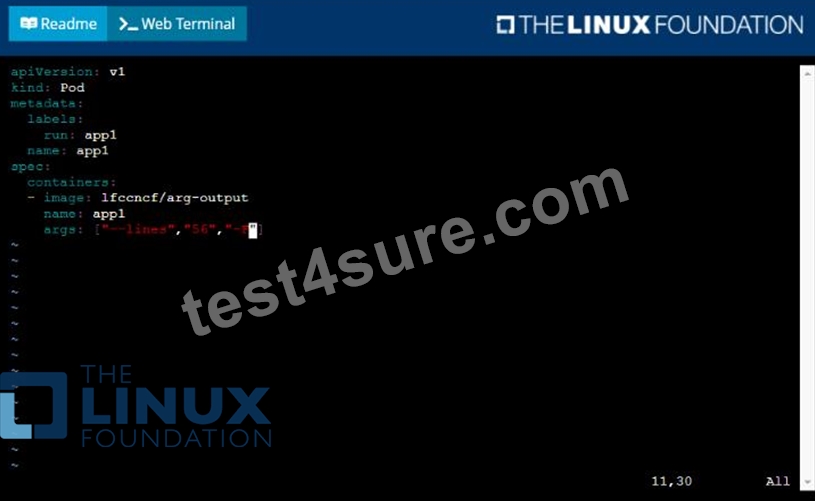
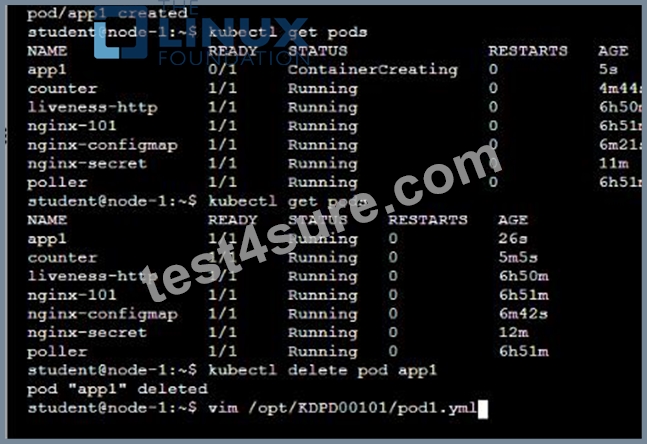
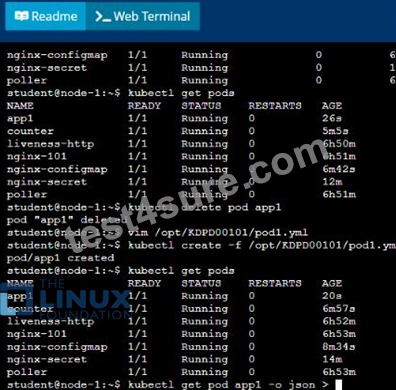
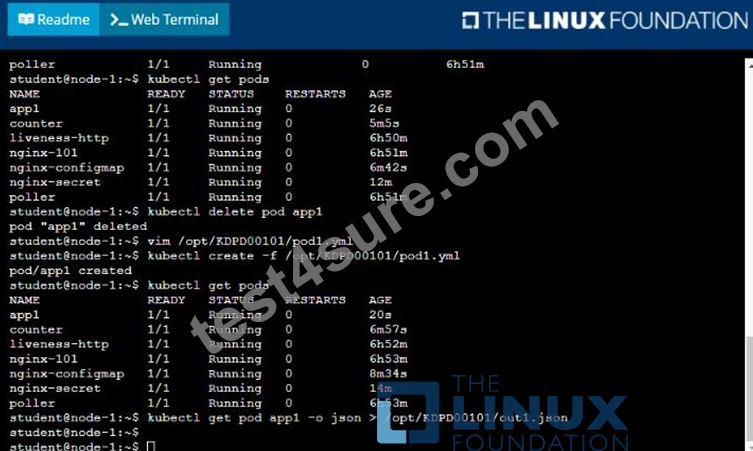
NEW QUESTION # 85 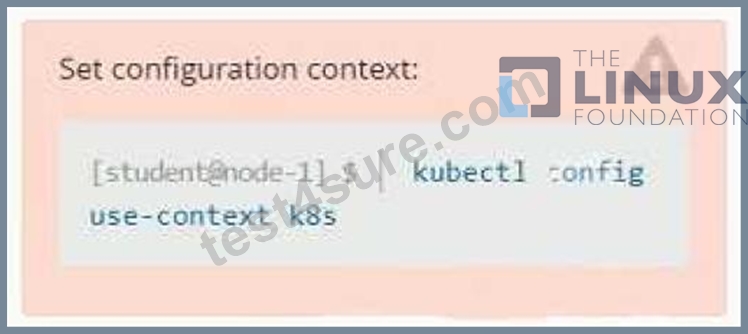
Context
A pod is running on the cluster but it is not responding.
Task
The desired behavior is to have Kubemetes restart the pod when an endpoint returns an HTTP 500 on the
/healthz endpoint. The service, probe-pod, should never send traffic to the pod while it is failing. Please complete the following:
* The application has an endpoint, /started, that will indicate if it can accept traffic by returning an HTTP 200.
If the endpoint returns an HTTP 500, the application has not yet finished initialization.
* The application has another endpoint /healthz that will indicate if the application is still working as expected by returning an HTTP 200. If the endpoint returns an HTTP 500 the application is no longer responsive.
* Configure the probe-pod pod provided to use these endpoints
* The probes should use port 8080
Answer:
Explanation:
See the solution below.
Explanation
Solution:
apiVersion: v1
kind: Pod
metadata:
labels:
test: liveness
name: liveness-exec
spec:
containers:
- name: liveness
image: k8s.gcr.io/busybox
args:
- /bin/sh
- -c
- touch /tmp/healthy; sleep 30; rm -rf /tmp/healthy; sleep 600
livenessProbe:
exec:
command:
- cat
- /tmp/healthy
initialDelaySeconds: 5
periodSeconds: 5
In the configuration file, you can see that the Pod has a single Container. The periodSeconds field specifies that the kubelet should perform a liveness probe every 5 seconds. The initialDelaySeconds field tells the kubelet that it should wait 5 seconds before performing the first probe. To perform a probe, the kubelet executes the command cat /tmp/healthy in the target container. If the command succeeds, it returns 0, and the kubelet considers the container to be alive and healthy. If the command returns a non-zero value, the kubelet kills the container and restarts it.
When the container starts, it executes this command:
/bin/sh -c "touch /tmp/healthy; sleep 30; rm -rf /tmp/healthy; sleep 600" For the first 30 seconds of the container's life, there is a /tmp/healthy file. So during the first 30 seconds, the command cat /tmp/healthy returns a success code. After 30 seconds, cat /tmp/healthy returns a failure code.
Create the Pod:
kubectl apply -f https://k8s.io/examples/pods/probe/exec-liveness.yaml
Within 30 seconds, view the Pod events:
kubectl describe pod liveness-exec
The output indicates that no liveness probes have failed yet:
FirstSeen LastSeen Count From SubobjectPath Type Reason Message
--------- -------- ----- ---- ------------- -------- ------ -------
24s 24s 1 {default-scheduler } Normal Scheduled Successfully assigned liveness-exec to worker0
23s 23s 1 {kubelet worker0} spec.containers{liveness} Normal Pulling pulling image "k8s.gcr.io/busybox"
23s 23s 1 {kubelet worker0} spec.containers{liveness} Normal Pulled Successfully pulled image
"k8s.gcr.io/busybox"
23s 23s 1 {kubelet worker0} spec.containers{liveness} Normal Created Created container with docker id
86849c15382e; Security:[seccomp=unconfined]
23s 23s 1 {kubelet worker0} spec.containers{liveness} Normal Started Started container with docker id
86849c15382e
After 35 seconds, view the Pod events again:
kubectl describe pod liveness-exec
At the bottom of the output, there are messages indicating that the liveness probes have failed, and the containers have been killed and recreated.
FirstSeen LastSeen Count From SubobjectPath Type Reason Message
--------- -------- ----- ---- ------------- -------- ------ -------
37s 37s 1 {default-scheduler } Normal Scheduled Successfully assigned liveness-exec to worker0
36s 36s 1 {kubelet worker0} spec.containers{liveness} Normal Pulling pulling image "k8s.gcr.io/busybox"
36s 36s 1 {kubelet worker0} spec.containers{liveness} Normal Pulled Successfully pulled image
"k8s.gcr.io/busybox"
36s 36s 1 {kubelet worker0} spec.containers{liveness} Normal Created Created container with docker id
86849c15382e; Security:[seccomp=unconfined]
36s 36s 1 {kubelet worker0} spec.containers{liveness} Normal Started Started container with docker id
86849c15382e
2s 2s 1 {kubelet worker0} spec.containers{liveness} Warning Unhealthy Liveness probe failed: cat: can't open
'/tmp/healthy': No such file or directory
Wait another 30 seconds, and verify that the container has been restarted:
kubectl get pod liveness-exec
The output shows that RESTARTS has been incremented:
NAME READY STATUS RESTARTS AGE
liveness-exec 1/1 Running 1 1m
NEW QUESTION # 86
......
Our CKAD Study Guide is famous for its instant download, we will send you the downloading link to you once we receive your payment, and you can down right now. Besides the CKAD study guide is verified by the professionals, so we can ensure that the quality of it. We also have free update, you just need to receive the latest version in your email address. If you don’t have it, you can check in your junk mail or you can contact us.
Examcollection CKAD Dumps: https://www.test4sure.com/CKAD-pass4sure-vce.html
2025 Latest Test4Sure CKAD PDF Dumps and CKAD Exam Engine Free Share: https://drive.google.com/open?id=1OzRa2k3qvqse6cVy0oT3xL1LT2RfyMyt
